Handwoven Kanvo fabric from Benin: a buyer's guide
· NVBB Nederland
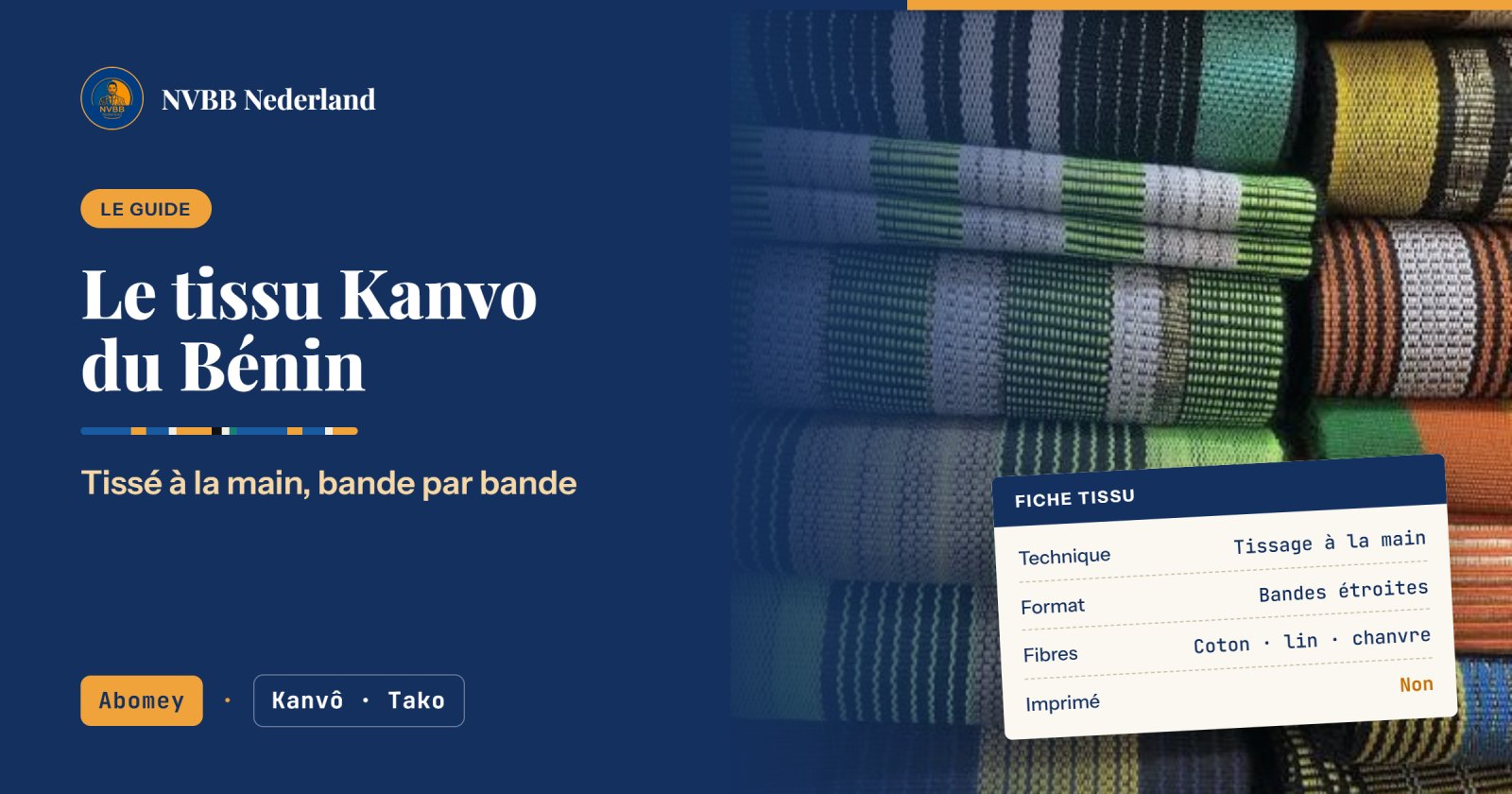
Kanvo is a fabric hand-woven in Benin in narrow strips. Its history, how it is made, how to use it and tips for buying it well in France and Europe.
Kanvo (also spelt kanvô) is a Beninese fabric woven by hand on a loom, in narrow strips sewn together. It is traditionally made of cotton, sometimes with linen or hemp. When buying, check that it is genuinely woven rather than printed, and ask who wove it and where.
What is Kanvo fabric from Benin?
According to Wikipedia, kanvô is a Beninese woven wrapper made of linen, hemp and cotton, traditionally made entirely by hand in Benin. Elle Afrique describes it as the only textile made entirely on Beninese soil for centuries. The pattern is therefore not printed onto a cloth: it comes from the threads themselves.
One fabric, two names
In the south of the country it is called kanvô, a Fon word. In the north, a similar woven cloth is called tako, in Baatonu. It is mainly produced by two peoples: the Fon in the south and the Baatonu in the north.
A royal cloth
Legend has it that King Agonglo of Abomey was so impressed by a weaver from Yoruba lands that he settled him at court. His son Guézo is said to have then extended its use to the nobility. Accounts vary: in the north, another tradition links the origin of tako to neighbours from Burkina Faso. What matters is that Kanvo was long a prestige cloth worn by rulers.
How is Kanvo made?
The fibres are hand-spun, dyed, then hand-woven into patterns. Weaving is done in narrow strips that are sewn side by side, which gives Kanvo its characteristic striped look. Around Abomey, weavers continue these skills: the feet work the pedals that control the warp threads while the hands guide the weft.
Why it takes skill
In its raw form, Kanvo is thick and heavy, which makes it hard to sew, as Afrik.com notes. Beninese tailors have adapted it to make it more supple. Africa Fashion Code also points out that ceremonial pieces could take months of work, and that its relatively high price has put some buyers off. A handmade fabric reflects the time it takes, which is why its price differs from that of an industrial fabric.
The Kanvô label: a Beninese initiative
In 2017 the Beninese government created the Kanvô Label to promote and protect this fabric, according to Elle Afrique. It is a public scheme run by Benin, separate from our own checks. With us, artisans are Verified artisans (listed in the CMA-Bénin register) and product quality is checked by NVBB (In Benin). We do not use the word “certified”: the CMA-Bénin keeps the register of trades and issues the professional card, but it does not certify products.
What we do with Kanvo in Heerlen
Through NVBB (In Benin), we buy fabrics from artisans in Benin and turn them in Heerlen into custom bags, shawls and laptop shells. We only work with fabrics made by hand in Benin: hand-woven Kanvo, hand-dyed batik, tie-dye (adire), indigo and hand-dyed bazin. We do not sell any industrially printed fabric.
Practical checklist: choosing a good Kanvo
- Look at the weave: narrow strips sewn together and patterns formed by the threads point to hand weaving.
- Check the reverse: a woven pattern is part of the structure, not simply laid on the surface.
- Accept small irregularities: slight variations in tension or colour are part of a handmade piece.
- Ask about origin: region, workshop, weaver. A serious seller answers precisely.
- Check the composition: cotton only, or cotton with linen or hemp.
- Think about use: a thick Kanvo suits bags, cushions or wall hangings; for clothing, choose a softened version.
- Care for it gently: as a general rule, hand wash in cold water and dry in the shade. Follow the artisan's own instructions first.
Going further
Every year, our KANVO Digital programme puts textile women artisans in the spotlight. Its first edition will take place in 2028. To learn how to buy African crafts well in Europe, see also our articles.
Conclusion
Kanvo is as much a memory as a material: woven by hand, it carries the skill of the people who make it. If you would like to see it in a bag or accessory made for you, discover our custom bags made from handmade fabrics of Benin or browse our creations.
Frequently asked questions
What is Kanvo?
Kanvo (kanvô) is a Beninese wrapper woven by hand in narrow strips, traditionally from cotton, sometimes with linen or hemp. In northern Benin it is called tako.
How can I recognise hand-woven Kanvo?
Look for narrow strips sewn together, a pattern formed by the threads (also visible on the reverse) and slight irregularities. Always ask about its origin and the maker.
Do you use industrially printed fabrics?
No. We do not sell any industrially printed fabric. We only use fabrics made by hand in Benin: Kanvo, batik, tie-dye (adire), indigo and hand-dyed bazin.
Can I order a custom Kanvo bag?
We sew custom bags, shawls and laptop shells in Heerlen from handmade fabrics of Benin. See our custom bags page for more information.
Sources
- fr.wikipedia.org
- elleafriquefrancophone.com
- www.afrik.com
- www.rosyneclub.com
- www.africafashioncode.net
- www.art-afric.com
- www.etourismbenin.com
- kamaataboo.com
Our articles are prepared with the help of AI, then reviewed and approved by our team before publication.
Read also
African crafts in the Netherlands: a guide to buying well
African crafts in the Netherlands: where to find creations from Benin, how to check the artisans behind them and what to know before you buy.